Michigan weather doesn’t give you much room for error. Bloomfield Hills winters regularly push below 20°F, and Southeast Michigan summers can feel brutal by late July. Whatever system heats and cools your home has to handle both extremes reliably, year after year.
If you’re shopping for a new system, replacing an aging unit, or just trying to understand what you already have, the options can feel overwhelming fast. Forced air, heat pumps, ductless mini-splits, boilers — each one comes with real trade-offs. This guide breaks down the main system types, explains how they perform in Michigan’s climate specifically, and helps you figure out which direction makes sense for your home.
The Core Types of Cooling and Heating Systems
Central Forced-Air Systems
This is the most common setup in Southeast Michigan homes. A gas furnace handles heating, a central air conditioner handles cooling, and both connect to the same ductwork to distribute conditioned air through vents in every room.
Why homeowners choose it:
- Familiar technology with a long service track record
- Gas furnaces hold up reliably even in sub-zero Michigan winters
- Parts and qualified technicians are widely available
- Works well in homes already built with ductwork
Where it falls short:
- Aging or poorly sealed ducts can bleed energy
- You’re maintaining two separate pieces of equipment
- Efficiency depends heavily on duct condition
For most existing homes in Royal Oak, Southfield, or Birmingham, a forced-air system is still the practical default. If your ducts are in good shape and your home is already set up for it, replacing like-for-like is often the most straightforward path.
Heat Pumps
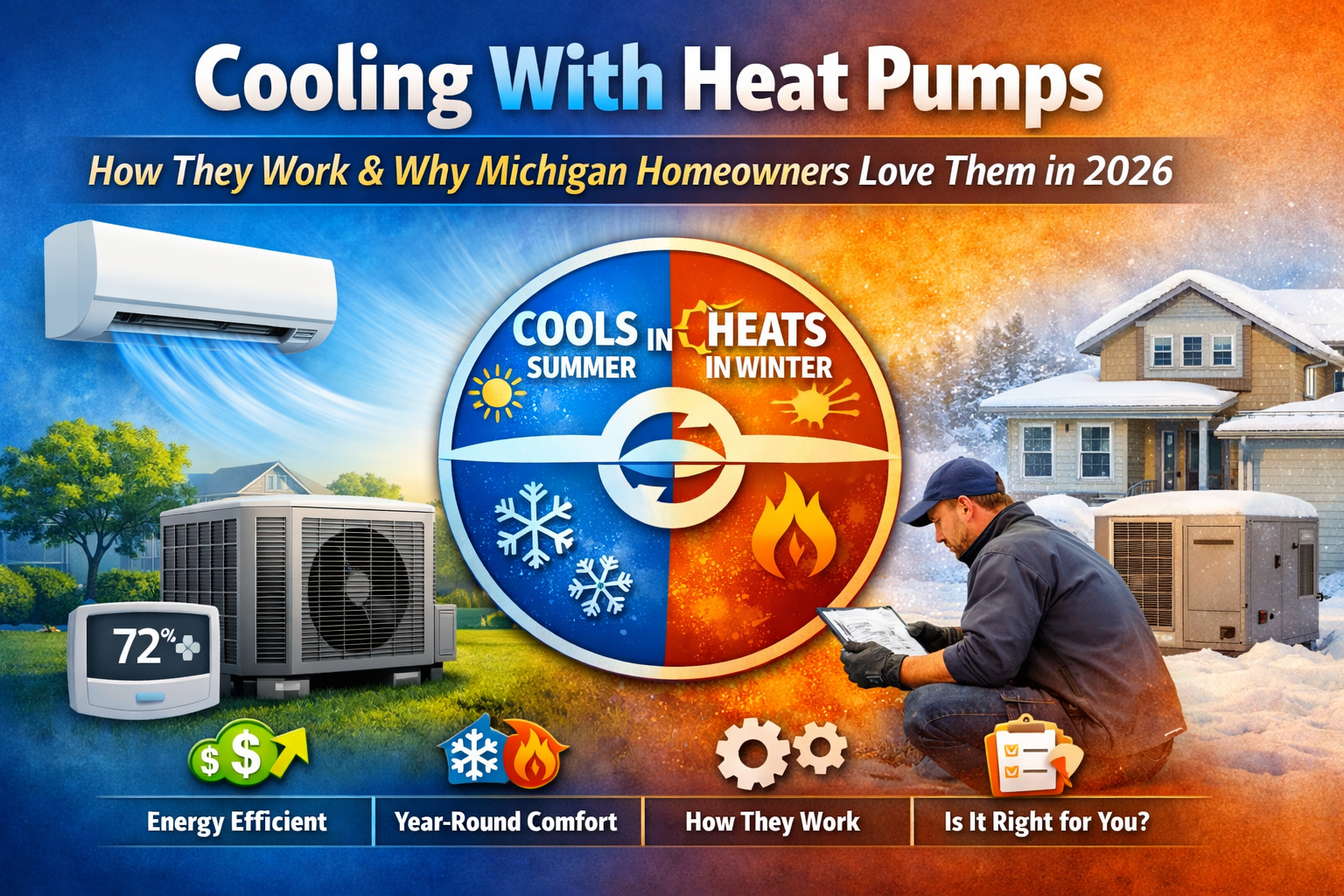
A heat pump moves heat rather than generating it. In summer, it pulls heat out of your home and pushes it outside. In winter, it reverses — pulling heat from outdoor air and bringing it in. One system handles both seasons.
Modern heat pumps have come a long way. Cold-climate models now operate efficiently well below freezing, which changes the conversation for Michigan homeowners who dismissed them in the past.
Why homeowners choose it:
- Single system for both heating and cooling
- Can be more energy-efficient than gas in moderate temperatures
- Reduces dependence on natural gas
Where it falls short:
- Performance drops in extreme cold; most Michigan homes with heat pumps still need a backup heat source for the coldest weeks
- Higher upfront cost than a standard furnace and AC pairing
- Not ideal as a standalone system when temperatures regularly drop below 0°F
If you’re building new or doing a full system replacement and want to cut your gas usage, a heat pump paired with a backup heat strip or gas furnace — called a dual-fuel system — is worth talking through with a technician.
Ductless Mini-Split Systems
A ductless mini-split pairs an outdoor compressor with one or more indoor air handlers mounted on walls or ceilings. No ductwork required. Each indoor unit conditions the space it serves.
Why homeowners choose it:
- Ideal for additions, finished basements, garages, or rooms that never had ductwork
- Highly efficient with no duct losses
- Each zone runs independently
- Quieter than most forced-air systems
Where it falls short:
- Higher cost per zone than extending existing ductwork in some cases
- Wall-mounted units aren’t the right look for every home
- Indoor heads need periodic professional cleaning
Ductless systems are one of the fastest-growing options across Southeast Michigan — especially for homeowners finishing a basement in West Bloomfield or carving out a home office in Novi. If you have a space your existing system doesn’t reach well, a mini-split is often the cleanest fix.
Boilers and Radiant Heat
Boilers heat water and distribute it through radiators or in-floor radiant tubing. No air movement at all. Many older homes in Berkley, Clawson, and Royal Oak still run on boiler heat.
Why homeowners choose it:
- Even, comfortable heat with no dry air or dust circulation
- Radiant floor systems feel particularly good in cold months
- Boilers tend to last a long time when properly maintained
Where it falls short:
- No built-in cooling — you still need a separate AC solution
- Radiant systems are expensive to install from scratch
- Not practical for most new installations unless you’re committed to the system type
If you already have a boiler, keeping it well-maintained is usually smarter than replacing it. Starting fresh with one usually means paying for a separate cooling system too, which pushes most buyers toward a combined option.
What Makes Michigan Different
Southeast Michigan’s climate is genuinely demanding. Your system needs to heat your home to 70°F when it’s 5°F outside, then turn around and cool it when July humidity makes 85°F feel like 95°F. That dual pressure rules out options that work fine in milder parts of the country.
A few things worth keeping in mind for Michigan specifically:
- Gas furnaces remain the most reliable primary heat source for the coldest weeks. Even efficient heat pumps can struggle below 0°F without a backup.
- Humidity matters in summer. A properly sized system removes moisture as it cools. An oversized unit short-cycles and leaves your home feeling clammy even when the thermostat reads right.
- Sizing is not optional. A system that’s too large or too small for your home’s square footage, insulation, and window area will underperform regardless of brand. A proper load calculation is the starting point for any new installation.
How to Choose: A Practical Framework
You don’t need to become an HVAC engineer. You just need to answer a few honest questions about your home and your priorities.
Does your home have existing ductwork in good condition? If yes, a central forced-air system is likely the most cost-effective path for whole-home comfort. If the ductwork is aging or poorly sealed, factor in repairs — or consider whether ductless makes more sense for problem areas.
Are you replacing one system or both? If your furnace and AC are both aging, replacing them together usually makes more sense than swapping one and leaving an old unit in place. A technician can assess both and give you an honest picture.
Do you have rooms your current system doesn’t reach well? Additions, finished lower levels, and converted spaces are prime candidates for a ductless mini-split. It’s often more efficient than trying to extend ductwork across a long run.
What matters more: lower monthly bills or lower upfront cost? Higher-efficiency equipment costs more upfront but saves on operating costs over time. Promotional financing can close that gap. Major HVAC purchases don’t have to wait — spreading the cost over time is a real option worth asking about.
What brand of equipment are you getting? Quality, efficiency ratings, and warranty terms vary. Bryant® systems are built for demanding climates and carry manufacturer backing that adds real peace of mind on a long-term purchase. Working with an authorized dealer means properly installed, warrantied equipment — not a grey-market unit.
Still not sure which direction fits your home? That’s exactly what a system assessment is for. High Comfort’s heating and cooling services cover the full range of options for Southeast Michigan homes, and a technician can walk you through what makes sense for your specific situation before you commit to anything.
Maintenance: The Factor Most Homeowners Underestimate
Whichever system you choose, how well you maintain it determines how long it lasts and how efficiently it runs. A neglected high-efficiency system will underperform a well-maintained standard one within a few years.
Annual pre-season check-ups are the most practical way to stay ahead of problems. Before Michigan’s heating season kicks in each fall, and again before the first real heat of summer, a technician can catch small issues before they turn expensive. Filter changes, coil cleaning, refrigerant checks, and electrical inspections all keep a system running at its rated efficiency.
Skipping maintenance is one of the most common reasons homeowners end up replacing systems earlier than they should.
FAQs
What cooling and heating system works best for Michigan winters? For most Michigan homes, a gas furnace paired with a central air conditioner is the most reliable combination. Gas furnaces hold strong performance even in sub-zero temperatures. Heat pumps can work well but typically need a backup heat source for the coldest stretches Southeast Michigan sees.
Is a heat pump a good choice for Southeast Michigan? Modern cold-climate heat pumps handle Michigan winters better than older models did. That said, most installers recommend pairing one with a backup heat source for the coldest weeks. A dual-fuel setup — heat pump plus gas furnace — gives you efficiency without sacrificing reliability when temperatures really drop.
What is a ductless mini-split and when does it make sense? A ductless mini-split connects an outdoor compressor to one or more indoor air handlers without ductwork. It’s a strong choice for additions, finished basements, garages, or any space your existing system doesn’t condition well. Because it eliminates duct losses entirely, it’s also highly efficient.
How do I know if my system needs to be replaced or just repaired? Age and repair history are the two biggest factors. If a system is more than 15 years old and has needed multiple repairs in recent years, replacement often makes more financial sense than continuing to patch it. A technician can assess the system and give you an honest comparison of repair costs versus replacement value.
Does equipment brand matter when replacing an HVAC system? Yes. Quality, efficiency ratings, and warranty terms vary by brand. Bryant® systems are designed for demanding climates and come with manufacturer backing. Working with an authorized dealer ensures proper installation and valid warranty coverage — which matters a lot over a 15 to 20-year system life.
How often should I schedule maintenance? Once per year at minimum, ideally twice. A pre-season check before the heating season and another before the cooling season catches problems early, keeps efficiency up, and extends equipment life. Annual maintenance is also often required to keep manufacturer warranties valid.
Can I finance a new HVAC system installation? Yes. Promotional financing is available for major HVAC purchases, so you don’t have to cover the full cost upfront. Spreading payments over time makes it practical to install the right system for your home rather than settling for a lower-quality option because of budget timing.
The Bottom Line
Choosing the right cooling and heating system for your Michigan home comes down to your existing setup, your home’s layout, and what you want from the next 15 to 20 years of ownership. There’s no single right answer — but there are clear wrong ones, and a qualified local technician can help you avoid them.
Whether you’re in Berkley, Birmingham, or anywhere across Southeast Michigan, High Comfort can assess your home and walk you through the options that actually fit. Schedule a consultation and get a straight answer before you spend a dollar.