Michigan summers have a way of sneaking up on you. One week you’re running the furnace, and the next you’re sweating through a Birmingham living room wondering why your old central AC can’t keep up. If you’ve been watching your energy bills climb and thinking there has to be a better way, heat pumps are worth a serious look.
More Southeast Michigan homeowners are choosing heat pumps in 2026 than ever before, and the reasons go well beyond cooling. Here’s how they work, why they hold up in Michigan’s climate, and what to think through before making the switch.
What a Heat Pump Actually Does
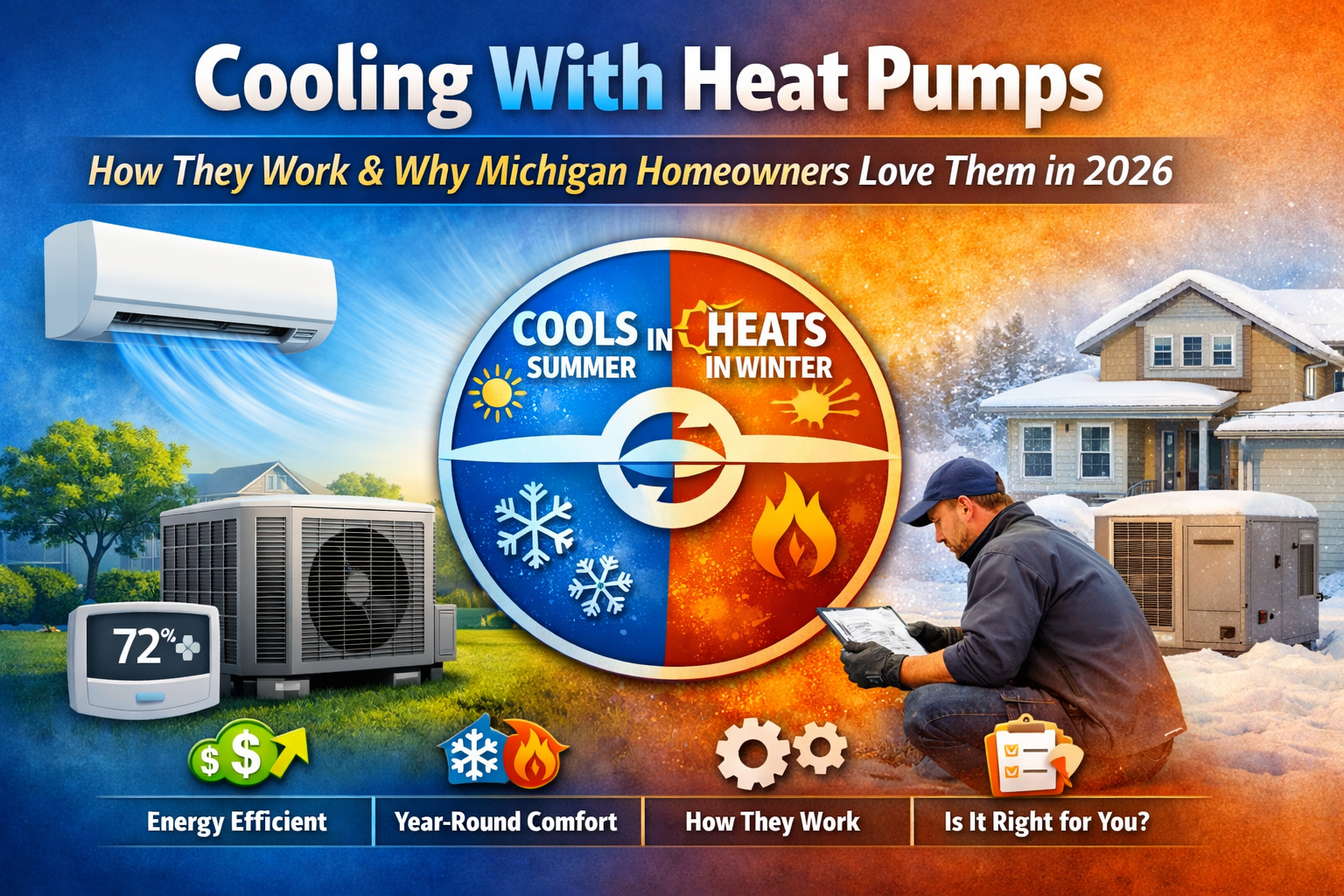
The name is a little misleading. A heat pump doesn’t generate heat the way a furnace does — it moves heat from one place to another.
In summer, it pulls heat from inside your home and pushes it outside, leaving your living space cooler. In winter, it reverses that process and draws heat from the outdoor air into your home. One system, both seasons.
That’s what makes cooling with heat pump technology fundamentally different from running a traditional air conditioner alongside a separate furnace. You’re not managing two systems anymore.
The Refrigerant Cycle
Heat pumps circulate refrigerant between an indoor unit and an outdoor unit. When the refrigerant evaporates, it absorbs heat. When it condenses, it releases heat. The direction of that cycle is what determines whether you’re heating or cooling.
Moving heat takes less energy than creating it, which is the core reason heat pumps are more efficient than conventional equipment.
Why Michigan’s Climate Is a Good Fit
There’s a persistent assumption that heat pumps struggle in cold climates. That was a real limitation with older equipment. Modern heat pumps — including models in the Bryant® lineup — are built to operate efficiently even when outdoor temperatures drop well below freezing.
Michigan winters are cold, but they’re not extreme by heat pump standards. For most of the heating season in places like Royal Oak, Novi, or West Bloomfield, a properly sized heat pump handles the load without issue. Many homeowners pair one with a backup heating element or an existing furnace for the coldest stretches — a setup called a dual-fuel system.
For summer cooling, heat pumps perform on par with a standard central air conditioner. Southeast Michigan’s warm, humid summers are well within their operating range.
The Efficiency Advantage
This is where heat pumps really stand out. A standard electric furnace converts electricity into heat at roughly a 1:1 ratio. A heat pump, because it moves heat rather than generates it, can deliver two to three times more heating or cooling energy than the electricity it consumes.
That ratio is measured as the Coefficient of Performance for heating and the SEER2 rating for cooling. Higher numbers mean lower monthly costs.
If your current system is aging or undersized, you may already be paying more than you need to. Replacing it with a modern heat pump can reduce those costs noticeably across a full year.
Ductless Heat Pumps: A Flexible Option
Not every home has existing ductwork, and not every room is served well by a central system. Ductless heat pumps — also called mini-splits — solve both problems.
A ductless system connects an outdoor unit to one or more indoor wall-mounted units. Each indoor unit can be controlled independently, so you’re only conditioning the rooms you’re actually using. That makes them a practical choice for additions, finished basements, or older homes in Bloomfield Hills or Beverly Hills that were built without ducts.
High Comfort installs and services ductless HVAC systems across Southeast Michigan. If you’re not sure whether a ducted or ductless setup makes more sense for your home, a system assessment can help you sort that out.
What to Consider Before Installing a Heat Pump
Switching to a heat pump is a bigger decision than a standard AC replacement. A few things are worth thinking through before you commit.
Your existing heating setup. If you have a gas furnace that’s still in good shape, a dual-fuel system might be the most practical path. The heat pump handles most of the work, and the furnace takes over on the coldest days when burning gas is more efficient than pushing the heat pump to its limits.
Home insulation and air sealing. Heat pumps are efficient, but they work best in a well-insulated home. If your home loses heat quickly through drafty windows or thin walls, addressing that before — or alongside — a heat pump installation will make a real difference.
System sizing. An oversized or undersized heat pump costs more to run and wears out faster. Proper sizing requires a load calculation based on your home’s square footage, insulation, window placement, and local climate data. A qualified technician handles this during the assessment.
Budget and financing. Heat pump installations typically cost more upfront than a standard AC unit — that’s a real consideration. Major HVAC purchases don’t have to wait, though. Promotional financing is available for qualifying installations, so you can spread the cost over time rather than absorbing it all at once.
Bryant® Heat Pumps: What the Dealer Status Means for You
High Comfort is an authorized Bryant® dealer and installer, and that matters for a few reasons.
Bryant® makes a full range of heat pump equipment, from entry-level units to high-efficiency models with variable-speed compressors. As an authorized dealer, High Comfort has direct access to that equipment and installs it to Bryant’s specifications — which affects both performance and warranty coverage.
A heat pump installed without proper authorization can void the manufacturer’s warranty. That’s a risk worth avoiding on a system you’ll rely on for the next 15 to 20 years.
Is a Heat Pump Right for Your Home?
If your current system is more than 12 to 15 years old, a heat pump is worth evaluating seriously. The technology has improved significantly, the efficiency gains are real, and handling both heating and cooling from one system simplifies your home’s mechanical setup for the long haul.
Whether you’re in Royal Oak, Southfield, Clawson, or anywhere else across Southeast Michigan, the team at High Comfort can assess your current setup and walk you through what a heat pump installation would actually look like for your home.
Frequently Asked Questions
Do heat pumps work in Michigan winters? Yes. Modern heat pumps are designed for cold climates and function well down to temperatures well below freezing. For the coldest stretches of a Michigan winter, many homeowners use a dual-fuel setup that pairs the heat pump with a gas furnace as backup.
Is a heat pump the same as an air conditioner? They use similar technology, but a heat pump does more. An air conditioner only cools. A heat pump can cool your home in summer and heat it in winter by reversing the refrigerant cycle.
How much does a heat pump cost to install in Southeast Michigan? Costs vary based on your home’s size, the type of system (ducted or ductless), and the equipment selected. Promotional financing is available for qualifying installations, so you don’t have to cover the full cost upfront.
What is a ductless heat pump and who needs one? A ductless heat pump — also called a mini-split — connects an outdoor unit to one or more indoor units without requiring ductwork. It’s a strong fit for homes without existing ducts, room additions, finished basements, or spaces a central system doesn’t reach well.
How long does a heat pump last? A well-maintained heat pump typically lasts 15 to 20 years. Annual pre-season maintenance check-ups help extend that lifespan and catch small problems before they turn into expensive repairs.
What does it mean that High Comfort is a Bryant® authorized dealer? It means High Comfort installs Bryant® equipment to the manufacturer’s specifications and has direct access to the full Bryant® product line. That protects your warranty and ensures the system is set up correctly from day one.
Should I replace my furnace with a heat pump or keep both? It depends on the age and condition of your furnace. If it’s relatively new and in good shape, a dual-fuel system — heat pump as the primary, furnace as backup — can be a smart approach. If your furnace is aging, replacing both at once may be the more practical call. A system assessment will give you a clear picture either way.
Heat pumps have earned their place in Southeast Michigan homes. The efficiency is real, the technology has caught up with the climate, and running both heating and cooling from one system makes long-term ownership simpler. If you’re ready to find out whether a heat pump makes sense for your home, reach out to High Comfort at high-comfort.com to schedule a consultation.