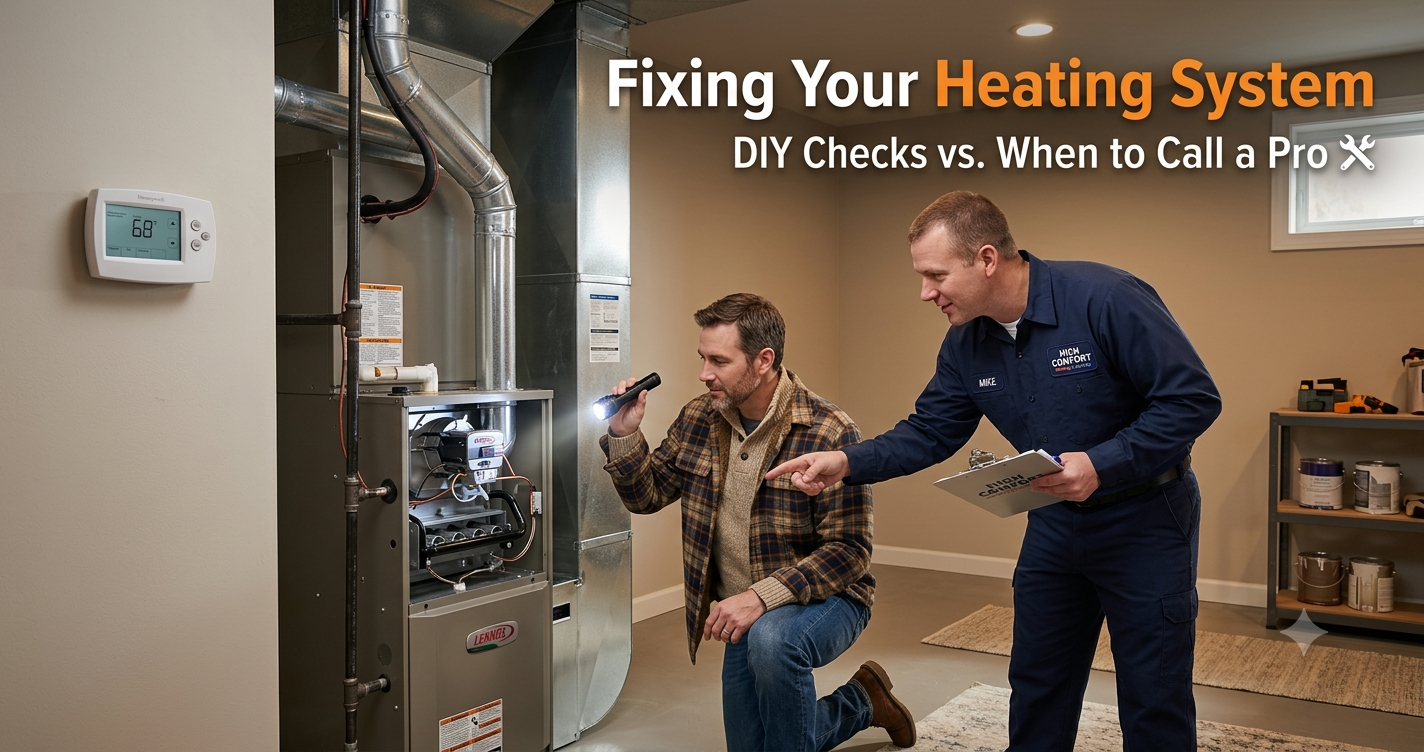
Your furnace stops working on a January night in Royal Oak. The house is getting cold fast, and you’re not sure whether to grab a flashlight and start troubleshooting or pick up the phone.
That moment of uncertainty is exactly what this guide is for.
Some heating problems are genuinely simple. A tripped breaker or a clogged filter can shut a system down, and you can fix either one in minutes. Others involve gas lines, heat exchangers, or electrical components that only a trained technician should touch. Knowing the difference saves you time, money, and the frustration of making things worse.
Here’s a practical breakdown of what you can safely check yourself — and when it’s time to call a pro.
Start With the Obvious: Quick DIY Checks First
Before assuming the worst, work through these basics. They resolve a surprising number of heating complaints.
Check Your Thermostat Settings
It sounds too simple, but it’s worth confirming. Make sure the thermostat is set to “Heat,” not “Cool” or “Fan Only.” Verify the set temperature is actually above the current room temperature. If you have a programmable or smart thermostat, check that the schedule hasn’t been accidentally changed.
Also replace the batteries if the display looks dim or unresponsive. A dead thermostat battery is one of the most common reasons a heating system appears to stop working.
Check the Filter
A severely clogged filter restricts airflow so much that the furnace overheats and shuts itself off as a safety measure. Pull the filter out and hold it up to the light. If you can’t see through it, replace it.
Filters in Southeast Michigan homes typically need changing every one to three months during heavy heating season. If yours looks like a gray wool blanket, start there.
Check the Circuit Breaker
Head to your electrical panel and look for any tripped breakers — they’ll sit between the “on” and “off” positions rather than snapping cleanly to either side. Flip it fully off, then back on. If the furnace starts, you’re done. If it trips again, stop and call a technician.
Check the Power Switch and Gas Supply
Furnaces have a power switch that looks like a standard light switch, usually mounted on the unit or a nearby wall. Make sure it’s on. It gets accidentally switched off more often than you’d think.
If you have a gas furnace, confirm the gas supply valve on the line leading to the unit is open. The handle should run parallel to the pipe — if it’s perpendicular, it’s closed.
Check the Condensate Drain Line (High-Efficiency Furnaces)
High-efficiency furnaces produce condensation as they run. If the condensate drain line gets clogged, a float switch shuts the system off to prevent water damage. Look for standing water near the furnace or a full condensate pan. Clearing a simple clog is a reasonable DIY task — but if you’re not sure what you’re looking at, leave it alone.
When the Simple Checks Don’t Fix It
If you’ve worked through everything above and the system still won’t heat properly, the problem runs deeper. This is where DIY ends and professional diagnosis begins.
If your furnace in Bloomfield Hills or Birmingham is still acting up after these checks, it’s worth scheduling a service call before the problem gets worse.
High Comfort serves Southeast Michigan homeowners with heating repair, installation, and maintenance. Contact the team to schedule a consultation and system assessment.
Signs You Need a Professional Repair
The Furnace Ignites but Shuts Off Quickly (Short Cycling)
Short cycling means the furnace fires up, runs for a minute or two, then shuts off before the house reaches temperature — and keeps repeating that pattern instead of completing a full heating cycle. Common causes include a faulty flame sensor, a cracked heat exchanger, or an oversized system. All three require a technician.
A cracked heat exchanger is worth taking seriously. It can allow combustion gases into your living space, which is a health concern. Don’t put this one off.
You Smell Gas
If you smell gas near your furnace, leave the house, leave the door open, and call your gas utility from outside or from a neighbor’s phone. Don’t flip any switches. Don’t use your phone inside. Once the utility clears the situation, have a technician inspect the system before running it again.
The Furnace Is Making Unusual Noises
A healthy furnace runs quietly. Banging, rattling, squealing, or grinding are all signals that something mechanical has failed or is on its way out. Banging on startup often points to delayed ignition. Rattling can mean a loose panel or a failing blower motor. These aren’t sounds to ignore through a Michigan winter.
Uneven Heating Across Rooms
If some rooms stay warm while others stay cold, the issue could be duct leaks, a failing blower motor, or a zoning problem. A technician can pinpoint which part of the system is underperforming.
Your Energy Bills Have Climbed Without Explanation
A heating system working harder than it should will show up in your utility bills. If your gas or electric costs have risen noticeably without a change in habits or weather, the system may be losing efficiency — often a sign of a component that’s wearing out.
The System Is More Than 15 Years Old and Struggling
Older furnaces don’t fail all at once. They degrade gradually. If your system is past the 15-year mark and you’re calling for repairs more than once a season, replacement is probably more economical than continued patching. Bryant® systems are built for long-term reliability, and an authorized dealer can help you weigh the cost of repair against a new installation.
The Annual Maintenance Check: The Best Prevention You Can Do
The most effective way to avoid emergency repairs is to schedule a pre-season maintenance check-up before heating season starts. A technician inspects the heat exchanger, cleans the burners, checks the flue, tests safety controls, and confirms the system is running efficiently.
This isn’t something you can fully replicate yourself — the diagnostic equipment and safety checks require a trained eye. But you can make it easy by booking it in early fall, before the first cold snap hits West Bloomfield or Novi and every HVAC company’s calendar fills up.
High Comfort offers annual pre-season maintenance check-ups designed to catch small problems before they become expensive ones.
What About Financing a Repair or Replacement?
If a technician tells you the system needs a major repair or full replacement, the cost can feel like a lot to absorb at once. Major HVAC purchases don’t have to wait or derail your budget. Promotional financing is available for larger jobs, so you can get the work done now and spread the cost over time.
That matters especially when you’re facing a system failure in the middle of a Michigan winter and waiting isn’t really an option.
DIY vs. Pro: A Quick Reference
| Situation | DIY or Pro? |
|---|---|
| Thermostat set incorrectly | DIY |
| Dead thermostat batteries | DIY |
| Clogged air filter | DIY |
| Tripped circuit breaker (first time) | DIY |
| Tripped breaker that trips again | Pro |
| Gas supply valve closed | DIY (if clearly visible and accessible) |
| Smell of gas | Leave and call utility immediately |
| Short cycling | Pro |
| Banging, grinding, or squealing noises | Pro |
| Cracked heat exchanger suspected | Pro |
| Uneven heating across rooms | Pro |
| Rising energy bills without explanation | Pro |
| System over 15 years old and struggling | Pro (assess replacement) |
| Annual pre-season tune-up | Pro |
Staying Ahead of Heating Problems in Southeast Michigan
Michigan winters don’t give much warning. A system that ran fine last March can fail on the first cold night of October if it hasn’t been serviced. The DIY checks in this guide take less than 20 minutes and can save you a service call. But when the problem goes beyond a filter or a breaker, a qualified technician is the right call.
If you’re in Berkley, Clawson, Southfield, or anywhere across Southeast Michigan and your heating system needs attention, High Comfort is ready to help. Contact the team to schedule a consultation, get a system assessment, and get your home warm again.
Frequently Asked Questions
Why does my furnace turn on but not produce heat? The most common causes are a clogged filter forcing the system to overheat and shut off, a faulty flame sensor preventing ignition from completing, or a problem with the gas supply. Start with the filter. If it’s clean and the problem continues, a technician should inspect the ignition system and flame sensor.
How often should I replace my furnace filter in Michigan? During active heating season, every one to three months is a reasonable range. Homes with pets, high dust levels, or older ductwork may need monthly changes. Check it visually every four weeks and replace it when you can no longer see light through it.
Is it safe to run my furnace if I hear a banging noise? A single bang on startup can indicate delayed ignition — meaning gas is building up before it ignites. Running the system repeatedly in that condition can damage the heat exchanger over time. Have a technician look at it before continuing normal use.
How do I know if my heat exchanger is cracked? You typically can’t see a crack without removing components. Signs include soot near the furnace, a strange smell when the heat runs, or carbon monoxide detector alerts. If you suspect a cracked heat exchanger, stop using the furnace and call a technician.
When does it make more sense to replace a furnace than repair it? A common guideline is to multiply the repair cost by the system’s age in years. If that number exceeds the cost of a new system, replacement is usually the better investment. Systems older than 15 years that need frequent repairs are strong candidates for replacement.
What does a pre-season maintenance check-up include? A technician cleans the burners, inspects the heat exchanger, tests safety controls, checks the flue for blockages, and confirms the system is running efficiently. It’s designed to catch small issues before they turn into mid-winter breakdowns.
Can I schedule heating service if I’m not sure what’s wrong? Absolutely. You don’t need to diagnose the problem before calling. A technician will assess the system and walk you through what they find. Contacting High Comfort to schedule a consultation is the straightforward first step.