Maybe a neighbor in Royal Oak had one installed. Maybe you’ve been researching ways to heat and cool a room addition without tearing into walls for ductwork. Either way, most Michigan homeowners hit the same wall: what does a ductless system actually cost, and does it make sense here?
This article breaks down realistic pricing for ductless mini-splits in Michigan, what pushes costs up or down, and how to figure out whether one is the right call for your home.
What Is a Ductless Mini-Split System?
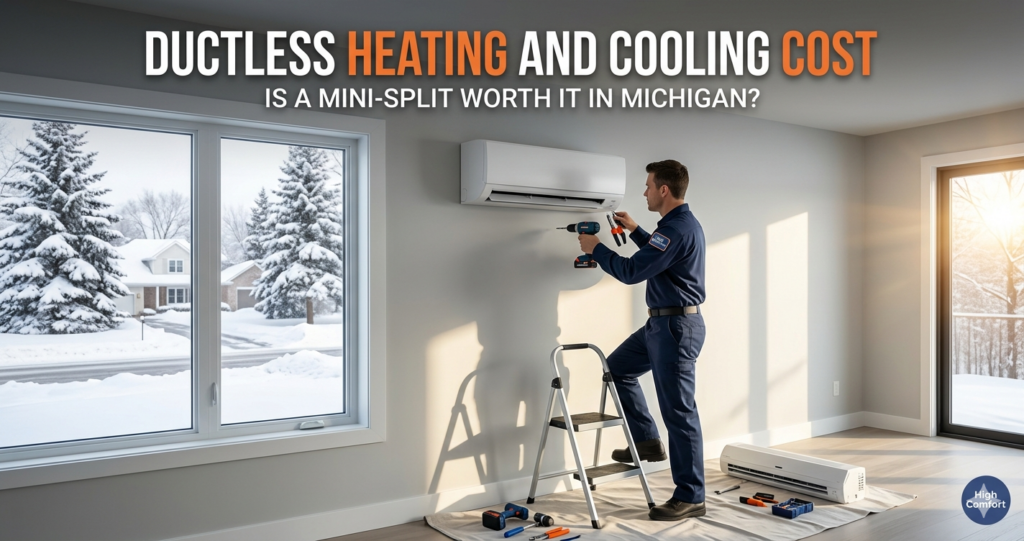
A mini-split has two main parts: an outdoor compressor and one or more indoor air handlers mounted on the wall or ceiling. They connect through a small conduit — no ductwork required.
A single-zone system heats or cools one room. A multi-zone setup handles several rooms independently, with each indoor unit controlling its own temperature. You’re only conditioning the spaces you’re actually using.
How Much Does Ductless Heating and Cooling Cost in Michigan?
Pricing depends on your home, the equipment, and how complex the installation is. Here are realistic ranges for 2026.
Single-Zone Mini-Split (One Room or Space)
For a single room — a home office, sunroom, finished basement, or bedroom — expect to pay between $2,500 and $5,500 fully installed. Smaller units in the 9,000 to 12,000 BTU range sit at the lower end. Larger units for bigger spaces push toward the top.
Multi-Zone Mini-Split (Two or More Rooms)
One outdoor unit connected to two to five indoor handlers typically runs $5,000 to $12,000 or more. If you’re using a multi-zone system to condition an entire home instead of replacing a central system, you could be looking at $10,000 to $15,000 depending on square footage and the number of zones.
What Drives the Cost Up or Down
- Brand and efficiency rating. Higher SEER2-rated equipment costs more upfront but lowers your energy bills over time. Bryant® ductless systems are built for efficiency and reliability — which matters when Southeast Michigan winters regularly push temperatures below freezing.
- Number of zones. Each additional indoor unit adds both equipment and labor cost.
- Installation complexity. Running conduit through finished walls, working around existing systems, or mounting units in tight spots takes more time.
- Electrical work. Mini-splits need a dedicated circuit. If your panel needs an upgrade or a new circuit run, that adds to the total.
- Location in the home. Attics, crawlspaces, and tight mechanical rooms slow the job down.
Is a Mini-Split Worth It in Michigan?
Michigan puts real demands on HVAC equipment. Winters in Bloomfield Hills and Birmingham can drop well below zero. Summers bring heat and humidity that make a poorly cooled room genuinely miserable. A mini-split has to hold up in both conditions to justify the cost.
Here’s where they make strong financial sense:
1. You’re Adding a Room or Finishing a Space
Finishing a basement, converting a garage, or adding a room addition? Running ductwork to that space can cost as much as — or more than — a mini-split. A single-zone system is often the cleaner, more cost-effective path.
2. Your Home Has No Ductwork
Older homes in Royal Oak, Berkley, and other Southeast Michigan suburbs were often built with boiler systems and no duct infrastructure. Retrofitting central forced-air into a home like that is expensive and disruptive. A multi-zone mini-split can condition the whole house without opening up walls and ceilings.
3. You Have Rooms That Never Feel Right
If certain rooms are always too hot or too cold no matter what the thermostat says, a mini-split targeted at those zones solves the problem directly — without changing how you heat and cool the rest of the house.
4. You Want to Cut Energy Costs
Mini-splits are significantly more efficient than electric baseboard heat and can outperform older forced-air systems. If you’re heating a space that currently relies on electric resistance heat, the energy savings can meaningfully offset the installation cost within three to five years.
That said, if you already have a newer, efficient central system and your home is well-insulated, the energy savings case is weaker. In that scenario, a mini-split makes more sense as a supplement than a full replacement.
If you’re trying to figure out whether a ductless system fits your home’s specific setup, High Comfort can assess your space and give you a clear picture of what installation would involve — no guesswork, just a straightforward look at your options.
What About Financing?
A $4,000 to $8,000 project isn’t a small purchase. For many homeowners in West Bloomfield or Southfield, the upfront cost is the main reason a system that would genuinely improve their comfort keeps getting pushed off.
Major HVAC purchases don’t have to wait. Promotional financing is available for ductless installations, so you can move forward with the right system now and spread the cost over time. When you’re comparing monthly payments against the energy savings a new system delivers, the math often looks a lot different.
Mini-Split vs. Central HVAC: A Quick Cost Comparison
| Situation | Mini-Split Estimate | Central HVAC Estimate |
|---|---|---|
| Single room or addition | $2,500 to $5,500 | $3,000 to $7,000+ (with ductwork) |
| Whole home, no existing ducts | $8,000 to $15,000 | $10,000 to $20,000+ |
| Supplementing existing system | $2,500 to $5,500 | Not applicable |
These are general estimates. Your actual cost depends on your home’s layout, the equipment selected, and local labor rates.
How Long Does a Mini-Split Last?
A well-maintained ductless system typically lasts 15 to 20 years. Annual pre-season service — cleaning filters and coils, checking refrigerant levels, inspecting electrical connections — keeps efficiency up and extends the system’s life. Skipping maintenance is the fastest way to shorten it.
High Comfort offers annual pre-season check-ups designed to catch small issues before they turn into expensive repairs. It’s a straightforward way to protect what you’ve invested in your system.
What to Ask Before You Buy
Before committing, get clear answers to these questions:
- What size unit does my space actually need? Oversizing wastes money; undersizing leaves you uncomfortable.
- How many zones do I realistically need?
- What’s the total installed cost, including any electrical work?
- What brand is being installed, and what does the warranty cover?
- Does the installer have experience with that specific brand?
Bryant® ductless systems come with manufacturer warranties that protect your investment. Working with an authorized Bryant® dealer means the installation meets the standards required to keep that warranty valid.
Getting a Ductless System Installed in Southeast Michigan
If you’re in Birmingham, Novi, Clawson, or anywhere across Southeast Michigan and you’re seriously considering a mini-split, the next step is a site assessment. The right system depends on your home’s layout, insulation, existing equipment, and what you’re actually trying to solve.
High Comfort installs and services ductless systems throughout the region. You can explore the full range of heating and cooling services available in Michigan and reach out to schedule a consultation.
Frequently Asked Questions
How much does it cost to install a ductless mini-split in Michigan? Most single-zone installations run between $2,500 and $5,500 fully installed. Multi-zone systems covering two or more rooms typically cost $5,000 to $12,000 or more, depending on the number of indoor units and how complex the installation is.
Is a mini-split efficient enough for Michigan winters? Yes. Modern mini-splits are rated to operate efficiently well below freezing. High-performance units like Bryant® ductless systems maintain heating capacity even in the coldest Southeast Michigan conditions, though very extreme cold may require a backup heat source in some configurations.
Can a mini-split replace my central heating and cooling system? In homes without existing ductwork, a multi-zone mini-split can serve as the primary system. In homes with existing forced-air, mini-splits are more commonly used to supplement central HVAC for specific rooms or zones.
How long does a ductless mini-split last? With regular maintenance, 15 to 20 years is typical. Annual pre-season service helps extend that lifespan and keeps efficiency from degrading over time.
Do I need to upgrade my electrical panel for a mini-split? Mini-splits require a dedicated circuit. Whether your panel needs an upgrade depends on its current capacity and the size of the unit. A technician can assess this during the initial consultation.
Is financing available for ductless mini-split installations? Yes. Promotional financing is available for major HVAC purchases including ductless systems, so you can move forward without covering the full cost upfront.
What’s the difference between a single-zone and multi-zone mini-split? A single-zone system connects one outdoor unit to one indoor air handler, conditioning one room or space. A multi-zone system connects one outdoor unit to two or more indoor handlers, allowing independent temperature control in different rooms at the same time.
A mini-split is worth it when the situation calls for it — a room without ductwork, a space that never heats or cools properly, or a home that needs a whole-house solution without the cost of installing new ducts. The key is matching the right system to your actual needs. Reach out to High Comfort to schedule an assessment and get a clear, honest recommendation for your home.