Your thermostat is the one device you interact with every day, yet most homeowners in Royal Oak, Bloomfield Hills, and across Southeast Michigan barely think about it — until the house won’t heat up in January or cool down in July.
If you’ve ever wondered whether your thermostat actually controls both your furnace and your air conditioner, or why some thermostats seem to do so much more than others, this guide is for you. Understanding how heating and cooling thermostats differ helps you make smarter decisions about your home comfort, your energy bills, and your next upgrade.
The Basic Job of Any Thermostat
A thermostat does one thing: it reads the temperature in your home and signals your HVAC equipment to turn on or off based on a setpoint you choose.
Simple enough. But how it does that job varies quite a bit depending on the type of thermostat you have and the system it’s connected to.
Heating-Only vs. Cooling-Only vs. Dual-Function Thermostats
Heating-Only Thermostats
Older homes — particularly those with boilers or radiant heating — sometimes have thermostats wired only to the heating side of the system. These units signal your furnace or boiler but have no connection to an air conditioner whatsoever.
If your home had central air added later as a separate system, it’s possible the two were never tied to the same thermostat.
Cooling-Only Thermostats
Less common in Michigan, but they do exist in spaces where cooling is the only mechanical need — server rooms, wine cellars, or additions with a standalone mini-split used purely for summer comfort.
Dual-Function (Heating and Cooling) Thermostats
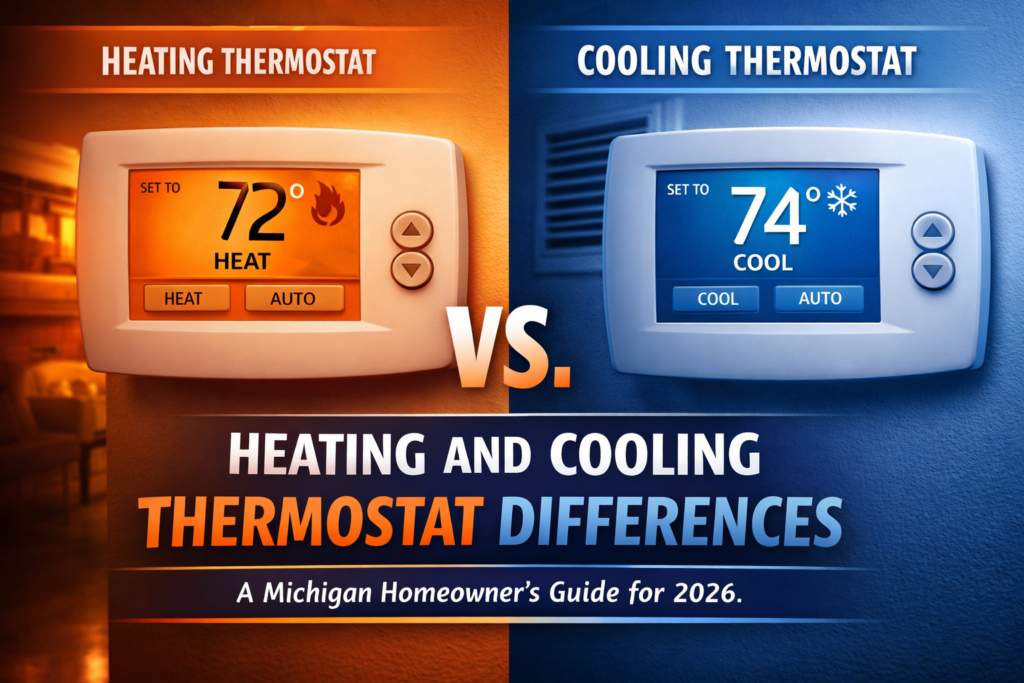
Most modern homes in Southeast Michigan use a single thermostat that handles both heating and cooling. You set it to “heat” mode for winter and switch to “cool” when summer arrives.
This is the standard setup for homes with a central forced-air furnace and a central air conditioner or heat pump. The thermostat communicates with both systems through separate wiring terminals — typically labeled W (heat), Y (cool), G (fan), R (power), and C (common).
How the Wiring Differs Between Heating and Cooling Modes
A thermostat doesn’t just flip one switch. It sends different signals depending on what you need.
- Heating mode: The thermostat closes the circuit on the W terminal, telling the furnace to fire. The fan may come on automatically once the heat exchanger warms up, or the thermostat can trigger it directly.
- Cooling mode: The thermostat closes the Y terminal, activating the compressor in your outdoor AC unit. The G terminal brings the air handler fan on at the same time.
- Fan-only mode: The G terminal runs the fan without calling for heat or cooling — useful for circulating air on mild Michigan spring days.
A heating-only thermostat typically has just two wires. A dual-function thermostat needs at least four or five, and smart thermostats often require a fifth C wire to maintain a steady power supply.
The Four Main Types of Thermostats in 2026
Manual (Non-Programmable) Thermostats
You set the temperature by hand, every time. No scheduling, no automation. These are still found in older homes and rentals, but they tend to waste energy because most people forget to adjust them when they leave or go to bed.
Programmable Thermostats
You set a weekly schedule — different temperatures for morning, daytime, evening, and overnight — and the thermostat handles the rest. For a homeowner in Southfield or Berkley who leaves for work at 8 a.m. and gets home at 6 p.m., a programmable thermostat can meaningfully cut energy use without any daily effort.
Smart Thermostats
Smart thermostats connect to your home Wi-Fi and let you control your system from a phone app, wherever you are. Many learn your schedule over time and adjust automatically. Some integrate with voice assistants and utility demand-response programs.
They also give you real-time data on how long your system ran each day — which is genuinely useful for catching efficiency problems before they turn into repair bills.
Multi-Stage and Zoning Thermostats
If your home has a two-stage furnace, a variable-speed air conditioner, or a zoned duct system, you need a thermostat built to communicate with those systems. A basic single-stage thermostat won’t unlock the efficiency those systems are designed to deliver.
Bryant® equipment, for example, is designed to work with compatible communicating thermostats that allow the system to modulate output rather than simply switching fully on or off. That matters a lot during Michigan’s shoulder seasons, when you need a little heat in the morning and a little cooling by afternoon.
Heat Pumps: A Special Case
Heat pumps complicate the thermostat picture because they provide both heating and cooling from a single outdoor unit. They require a thermostat with an O or B terminal to control the reversing valve — the component that switches the system between modes.
Install a standard cooling thermostat on a heat pump and the system may run in the wrong mode entirely. This is exactly why thermostat compatibility matters as much as the thermostat itself.
If you’re considering a ductless heat pump or mini-split for a room addition or older home in West Bloomfield or Clawson, the setup is different again. Most ductless systems use a handheld remote or a wall-mounted controller specific to that unit rather than a whole-home thermostat.
What Actually Matters When Choosing a Thermostat in Michigan
Michigan’s climate puts real demands on your HVAC system. Winters in Birmingham and Novi push furnaces hard for months. Summers bring humidity that your AC has to manage alongside temperature. Here’s what to think about before you buy.
Compatibility with your equipment. Not every thermostat works with every system. Before purchasing anything, confirm the thermostat is rated for your furnace type — single-stage, two-stage, or modulating — as well as your AC or heat pump and your existing wiring.
C wire availability. Smart thermostats need a continuous power source. Many older homes don’t have a C wire run to the thermostat location. A technician can add one, or you can use a compatible adapter, but it’s worth knowing before you buy.
Scheduling that fits your life. A 7-day programmable or smart thermostat pays for itself quickly when you use it consistently. A manual thermostat is fine if you genuinely prefer hands-on control, but most homeowners benefit from some level of automation.
Integration with your system’s features. If you have a Bryant® system with variable-speed or two-stage operation, pairing it with a communicating thermostat designed for that equipment gets you the full efficiency benefit. A mismatched thermostat leaves real performance on the table.
Not sure what type of thermostat you currently have or whether it’s compatible with your system? That’s a great question to raise during a service call. The team at High Comfort can assess your setup and recommend the right match for your equipment and your home.
Common Thermostat Problems That Mimic System Failures
Before you assume your furnace or AC is broken, consider whether the thermostat itself is the issue. These problems are common and often misdiagnosed.
- Short cycling: The system turns on and off too frequently. This can be caused by a thermostat placed near a heat source, a drafty window, or a failing temperature sensor inside the unit.
- No response to setpoint changes: If you adjust the temperature and nothing happens, check whether the thermostat has power, whether the mode is set correctly, and whether the display is functioning.
- Temperature inaccuracy: If the room feels much warmer or cooler than the thermostat reads, the sensor may be dirty, damaged, or poorly placed.
- Blank display: Could be a dead battery, a tripped breaker, or a wiring issue at the thermostat base.
Many of these are quick fixes. If the thermostat checks out and the system still isn’t performing, the problem lies elsewhere.
When to Replace vs. Repair Your Thermostat
Thermostats are relatively inexpensive compared to the rest of your HVAC system. If yours is more than 10 years old, uses outdated technology, or keeps causing problems, replacement usually makes more sense than repair.
Upgrading to a programmable or smart thermostat at the same time as a furnace or AC replacement is a natural opportunity to get the most out of new equipment. Major HVAC purchases don’t have to strain your budget all at once — promotional financing is available for larger system upgrades, making it easier to do the job right the first time.
FAQs
Can one thermostat control both heating and cooling?
Yes. Most modern homes use a single dual-function thermostat that controls both the furnace and the air conditioner. You switch between heat and cool modes manually, or set the thermostat to “auto” mode, which activates whichever system is needed based on the indoor temperature.
Do heating and cooling thermostats use different wiring?
They use different terminals on the same wiring base. A heating call uses the W terminal, a cooling call uses the Y terminal, and the fan uses the G terminal. A heating-only thermostat may have just two wires, while a full heating and cooling thermostat typically needs four or five.
Will any thermostat work with my furnace and AC?
Not necessarily. Compatibility depends on your system type — single-stage, two-stage, heat pump, or communicating — along with your wiring and whether a C wire is present. Always confirm compatibility before purchasing, especially for smart or programmable models.
What is a C wire and do I need one?
The C wire (common wire) provides a continuous 24-volt power supply to the thermostat. Smart thermostats require it to stay powered and connected to Wi-Fi. Many older homes in Southeast Michigan don’t have one installed, but a technician can add it or install a compatible adapter.
Why does my thermostat say one temperature but the room feels different?
The thermostat’s internal sensor may be reading incorrectly due to its location near a heat source, a drafty area, or direct sunlight. A dirty or aging sensor can also throw off the reading. Relocating the thermostat or replacing the sensor often resolves it.
Can I install a smart thermostat myself?
Many homeowners do, and manufacturers provide step-by-step instructions. That said, if your system is a heat pump, has multi-stage operation, or lacks a C wire, professional installation reduces the risk of compatibility problems or wiring errors.
How often should I replace my thermostat?
There’s no fixed schedule, but most thermostats last 10 to 15 years. If yours is causing temperature inconsistencies, failing to respond, or simply lacks features that would improve your comfort and energy use, it’s worth replacing — especially when you’re already upgrading other parts of your system.
Get the Right Setup for Your Home
Thermostats seem simple, but the differences between types matter more than most homeowners realize — especially in a Michigan climate where your system works hard in both directions every year.
If you’re in Birmingham, Novi, Royal Oak, or anywhere across Southeast Michigan and you’re not sure whether your thermostat is the right match for your equipment, reach out to High Comfort to schedule an assessment. A quick look at your setup can save you from mismatched equipment, wasted energy, and avoidable repair calls down the road.